Identity governance across the full access lifecycle
It provisions and removes access as people join, move, and leave, enforces segregation of duties, runs access reviews, and records each decision for audit. The six use cases below are the scenarios we have documented in full. They are examples of the work IDHub handles, not a complete list.
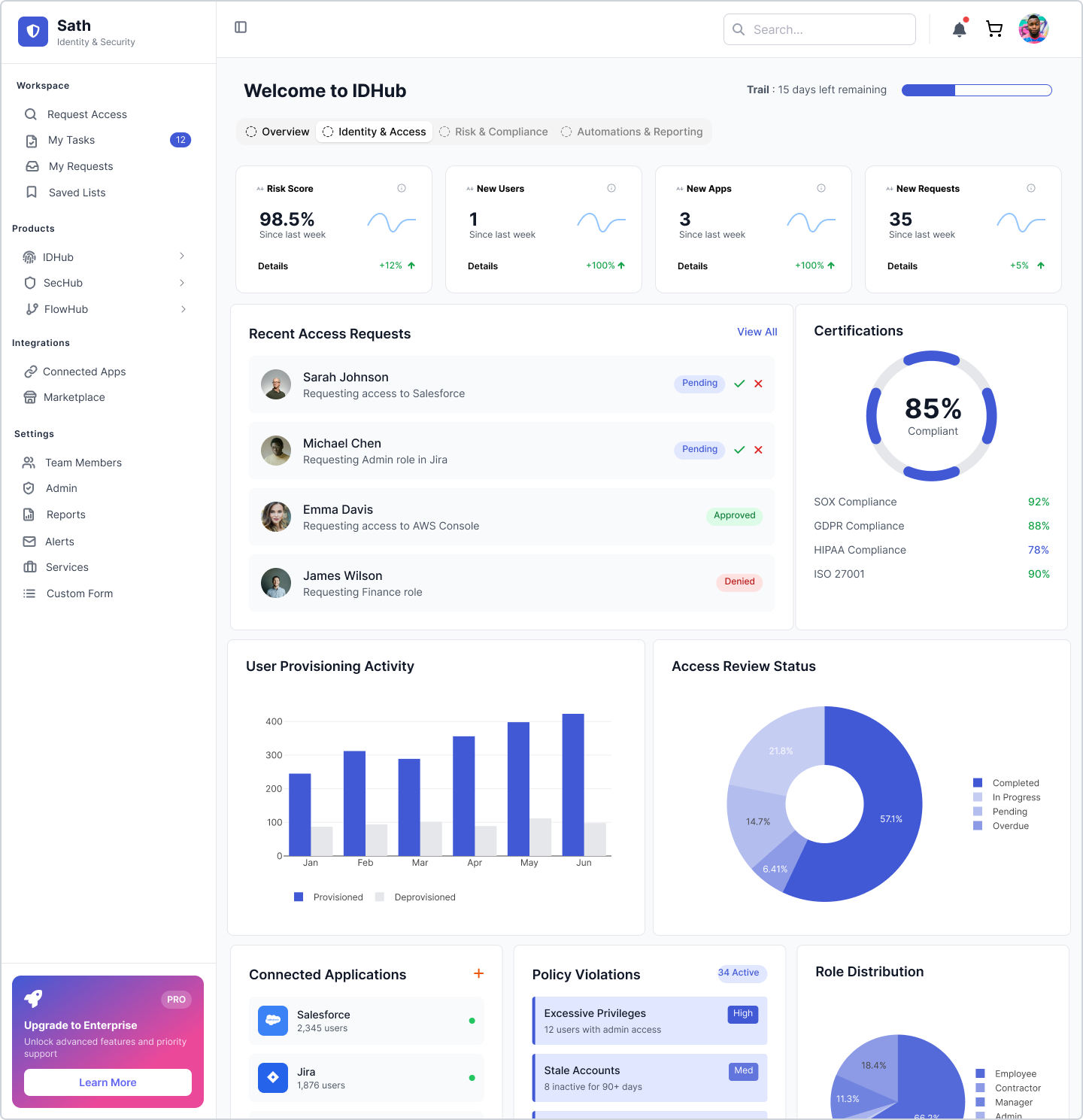
Why Access Diverges from Policy
Compliance writes the policy. HR records the hire, the transfer, or the departure. IT changes access, usually when a ticket arrives. Each team works from its own records, and nothing forces those records to agree.
The gaps are easy to recognize. A departed employee’s application accounts stay active until someone files the request. A transfer adds new access and keeps the old. An account with no remaining owner stays open. An approval sits in an email thread that nobody can find at audit time.
The result is access that policy does not allow and no record explains. When an auditor asks who had access, who approved it, and when, the answer has to be assembled by hand from separate systems. When someone misuses one of these accounts, the activity uses valid credentials and looks like normal work.
IDHub ties access changes to the HR record and to policy rules. A hire, transfer, or departure starts the matching changes in directories and applications. Access is assigned by role and checked against segregation of duties rules. Approvals, changes, and reviews are recorded automatically, so you can show how any account came to have its access.
Use Cases by Security Objective
The entries follow these security objectives in turn: governing access across the enterprise; controlling how access is granted, changed, and removed; meeting regulatory obligations and demonstrating compliance to auditors; and detecting misuse of valid accounts. Each entry states when the use case applies and what it covers, then links to the full page.
Identity Security and Governance
Applies when: you cannot say with confidence who has access to what across the enterprise.
Access accumulates through hybrid environments, fast onboarding, and accounts nobody retired. This use case covers role-based access control, segregation of duties rules, account provisioning and removal, access reviews, and entitlement visibility across connected applications. It is the broadest of the six.
Access Lifecycle Automation
Applies when: access does not keep pace with people joining, changing roles, or leaving.
Access that depends on IT tickets can fall behind HR changes in both directions: new hires wait for accounts, and former employees keep theirs. This use case covers Joiner, Mover, and Leaver processes triggered by changes in the HR system, default access based on role, and a review of someone's access when their department changes.
Security Workflow Automation
Applies when: access requests and approvals still run through tickets and manual routing.
Requests that arrive through several channels tend to get inconsistent handling and leave scattered records. This use case covers the workflow engine that connects HR systems, directories, and applications: approvals routed by risk and policy, access assigned by role, privileged access that expires automatically after a set period, and automatic suspension of access that breaks a segregation of duties rule.
Risk & Compliance Management
Applies when: regulatory mandates require the same access controls to work across cloud and on-premise systems.
Organizations subject to SOX, SOC 2, GDPR, HIPAA, or ISO 27001 have to show their access controls working in each in-scope system, wherever it runs. This use case covers segregation of duties checks, access certifications triggered by lifecycle events such as transfers and promotions, combined role-based and attribute-based access rules, detection and removal of orphan accounts, and deployment as cloud, on-premise, or air-gapped.
Audit & Reporting Readiness
Applies when: an auditor or regulator will ask who had access, who approved it, and when.
Audit proof gathered by hand from separate systems is slow and prone to gaps. This use case covers automated audit trails, records of access certifications, dashboards that reflect current access, and visibility into roles and entitlements, which together support audit preparation and regulatory reporting.
Threat Detection & Response
Applies when: you need to detect and respond to the misuse of valid accounts and privileges.
Activity that uses valid credentials looks like normal use, which makes misuse hard to see. This use case covers detection at the identity layer: correlating activity across applications and directories, starting access reviews from risk signals, automated responses such as access revocation or step-up authentication, and activity trails for investigations.
Start with the access question your team cannot answer
The longer you wait to modernize your Identity Security and Governance, the higher your risk of a catastrophic breach or massive compliance penalty. Take absolute control of your enterprise identity today. Who has access to what, who approved it, and when? If answering means searching several systems and email threads, find the use case above that matches your situation, then see how IDHub handles it in the demo.
Cybersecurity Tools