Cross Tool Orchestration
Most enterprises have not built a connected security and IT environment. They have accumulated one through individual integration projects, team-level decisions, and vendor-supplied connectors that were stood up without central oversight. The result is a connection layer that nobody owns, that carries credentials nobody tracks, and that fails in ways nobody is monitoring. FlowHub, provides the governed orchestration layer that enterprise security and IT operations require to manage tool connectivity as infrastructure.
.png)
The Integration Problem That Enterprises Misdiagnose
When security leaders describe disconnected operations, they typically frame it as a visibility problem or a tooling problem. The more precise diagnosis is an integration governance problem. The tools exist. The integrations, in many cases, exist. What does not exist is a coherent, governed model for how those integrations were built, what credentials they use, who owns them, how failures are detected, and whether the connections still reflect current security policy.
The specific failure patterns are consistent:
Credential sprawl without ownership records. Every point integration carries credentials — API keys, service account tokens, OAuth grants. These credentials were created when the integration was built. In most environments, no system tracks which integrations hold credentials to which systems, when those credentials were last rotated, or what access scope they carry. When a credential is compromised or a service account is over-permissioned, identifying the blast radius requires manual investigation across systems that were never designed to answer that question.
Integrations that survive the people who built them. Point-to-point integrations built by individual engineers or teams carry undocumented logic, hardcoded values, and assumptions about system behavior that were accurate when the integration was built. When the engineer leaves, that knowledge leaves. When a connected system updates its API, the integration breaks — often silently, without alerting anyone, until someone notices a process that stopped working weeks earlier.
No standard for how connected systems behave under failure. When a connection fails — authentication expires, an API endpoint changes, a system goes offline — most point integrations fail without structured error handling, without alerting, and without any log that would allow reconstruction of what was affected. Security and compliance processes that depend on these integrations stop executing without notification.
An integration layer that cannot be audited. When a regulator or internal auditor asks which external systems have API access to your SIEM, your identity platform, or your privileged access management system, the honest answer in most environments is: we do not have a complete list. That answer represents a control gap, and most compliance frameworks treat it as one.
This is not a tooling investment gap. It is an operational discipline gap in how the connection layer between tools is governed.
Key Capabilities
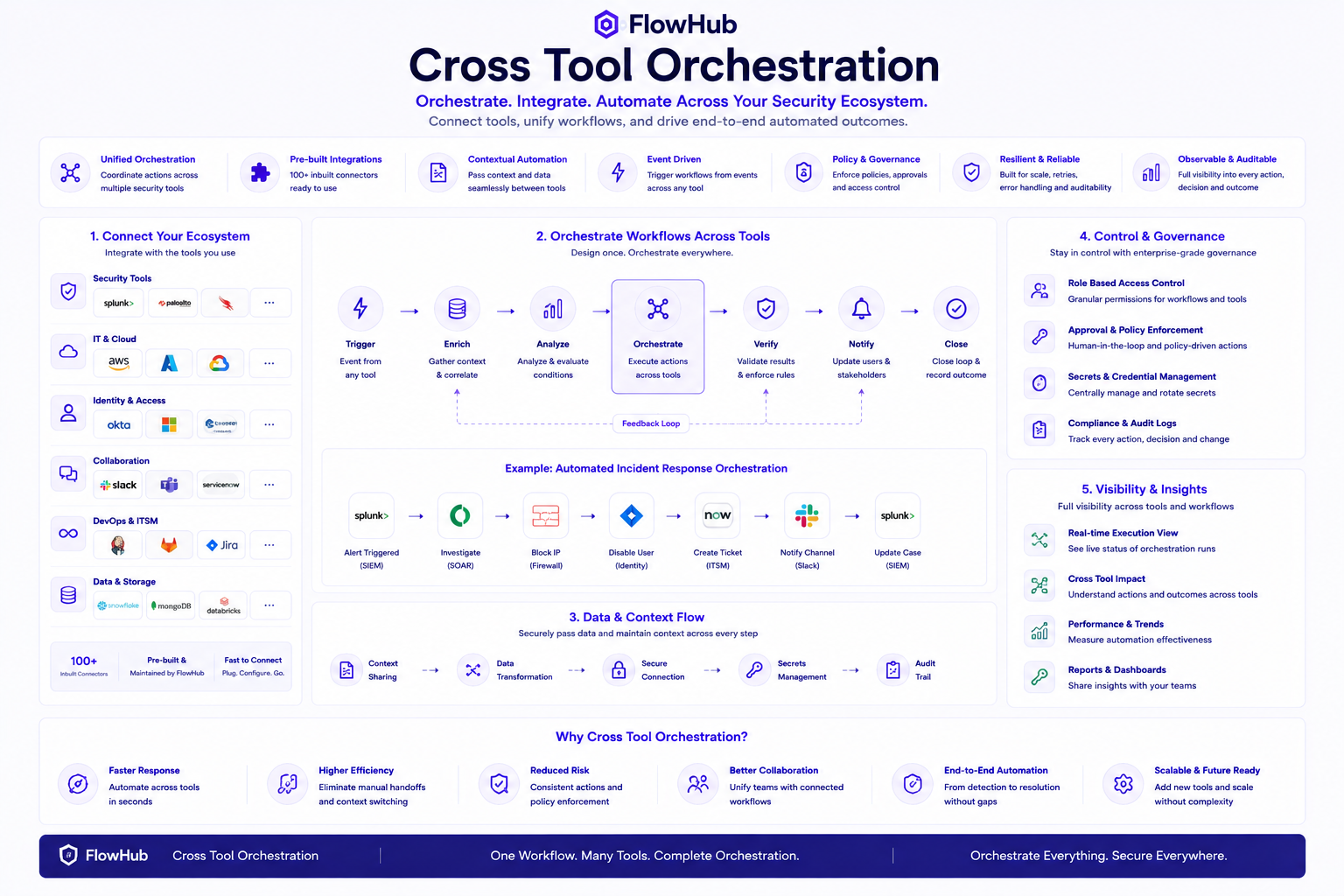
Connector Lifecycle Management
Connector Lifecycle Management Enterprise tool environments change. Vendors update APIs. Systems are replaced. Scope requirements change with policy. FlowHub manages the full lifecycle of each connector, initial onboarding and configuration, ongoing health monitoring, controlled updates when connected systems change, and formal decommissioning when connections are retired. Connector status, ownership, and configuration history are maintained centrally. An engineer leaving the team does not leave behind an undocumented integration that no one can safely modify or decommission.
Approval Workflow Architecture
Approval Workflow Architecture Not every automated action across enterprise systems should execute without human review. FlowHub's workflow model includes structured approval gates defined points in a workflow where execution pauses, a designated reviewer is notified, and the workflow proceeds only upon explicit authorization. Approval steps carry full context: what triggered the workflow, what has already executed, and what action requires approval. The reviewer's decision and the time at which it was made is recorded as part of the workflow execution log.
Multi-System Workflow Sequencing
Multi-System Workflow Sequencing Cross-system workflows that require actions across multiple connected platforms execute within FlowHub with defined sequencing, conditional logic, and structured failure handling. If a step fails, the failure is logged, the workflow behavior follows configured failure logic (pause, retry, escalate, or compensate), and the operations team is alerted. The workflow does not silently stop and leave connected systems in an inconsistent state the failure is visible, attributed, and handled according to defined logic.
Scheduled and Event-Initiated Orchestration
Scheduled and Event-Initiated Orchestration Workflows initiate from two primary models. Event-initiated workflows respond to conditions in connected systems: a change in system status, a data threshold, a record created in a connected platform, or a signal from an external source. Scheduled workflows execute at defined intervals, independent of event conditions used for periodic compliance tasks, credential rotation enforcement, access review initiation, and operational hygiene processes that must run consistently regardless of whether an event occurs.
Cross-Tool Orchestration as an Enterprise Infrastructure Discipline
The conventional framing for this problem is "integration." That framing undersells what is actually required.
Individual integrations are tactical decisions — connecting system A to system B for a specific purpose. Cross-tool orchestration is a structural decision — establishing a governed, managed layer through which enterprise systems connect, and ensuring that layer operates with the same controls applied to other critical infrastructure.
The distinction matters operationally. A single integration can be built by a team, documented minimally, and maintained informally. An orchestration layer is owned centrally, governed formally, and managed with the same discipline applied to network infrastructure or identity management: defined ownership, change control, access governance, and continuous operational monitoring.
For enterprises operating in regulated environments or under security frameworks that require demonstrated control over system interactions, the difference between "we have integrations" and "we govern our integration layer" is not semantic. It is the difference between a defensible control posture and an audit finding.
Cross-tool orchestration also enables something point-to-point integrations cannot: workflows that coordinate actions across multiple systems in a defined sequence, with conditional logic, approval gates, failure handling, and a complete execution record. That capability is architecturally dependent on a managed orchestration layer. It cannot be assembled reliably from individual integrations built in isolation.
What Governed Orchestration Changes in Practice
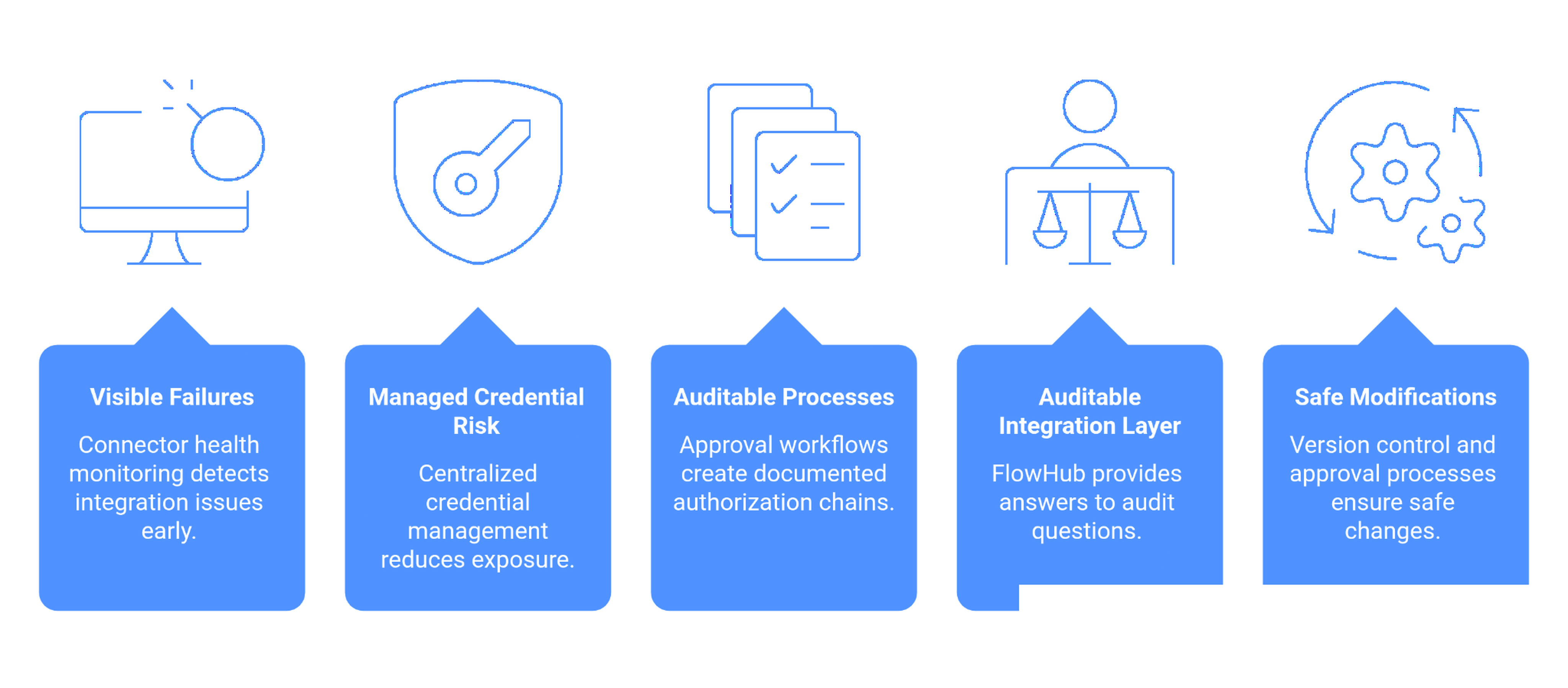
Integration failures become visible before they become incidents. Connector health monitoring and structured failure handling mean that a broken integration is detected and attributed within the platform, not discovered weeks later when a process is found to have stopped working.
Credential exposure from integrations becomes a managed risk. When every credential used by an integration is centrally held, access-controlled, rotation-enforced, and auditable, the credential sprawl pattern that produces common audit findings does not accumulate. The credential risk associated with the integration layer is treated as a security control, not as an operational afterthought.
Approval-dependent processes become auditable. Multi-stage approval workflows across enterprise systems produce documented authorization chains. Who approved what, when, with what context, is a byproduct of the workflow executing — not a separate documentation project.
The integration layer can be audited. When a regulator, an auditor, or an internal review asks which systems have API access to what, which credentials are active, which workflows executed last quarter, and who authorized each one, those answers are available from FlowHub's records without requiring manual investigation across disconnected systems.
Teams can modify integrations safely. Version control and approval processes for workflow and connector changes mean that modifications follow a controlled path. Engineers can update integrations without the risk that an untested change silently affects a production workflow. Rollback to a prior configuration is a deliberate, logged operation.
Business Benefits
Governance and Security Architecture
FlowHub's security posture is designed to withstand the scrutiny that enterprise security teams apply to platforms that sit at the center of their tool connectivity.
Access to the platform is role-differentiated. Connector administrators, workflow designers, workflow approvers, credential managers, and read-only operational viewers have explicitly scoped access. No role combines the ability to create workflows, manage credentials, and approve deployments — separation of duties is enforced in the platform model, not dependent on process.
Workflow deployments to production require explicit approval from a designated approver role, and that approval is logged with identity and timestamp. Configuration changes to production connectors follow the same model. The production environment cannot be modified through an informal change path.
For organizations operating under compliance frameworks that govern automated system interactions, FlowHub's architecture supports the control requirements those frameworks specify: documented access controls, change management evidence, continuous audit logs, and separation of duties in platform administration.
Where Enterprises Apply Cross-Tool Orchestration
Multi-system approval workflows for access and change management Access requests or configuration changes that require sequential approval from security, IT, and business stakeholders — across different platforms, with documented authorization at each stage — are structured as FlowHub approval workflows. Each approver receives relevant context in their system of record. The approval chain is complete and auditable.
Integration layer audit readiness Organizations facing compliance audits or security assessments use FlowHub's connector registry and credential management records to produce a current, complete picture of which systems are connected, through which credentials, with what scope. This answers a question that previously required manual investigation and was frequently incomplete.
Cross-team IT and security coordination workflows Workflows that require coordinated action between IT operations and security — vulnerability remediation sequencing, hardening verifications, configuration drift correction — execute through FlowHub with defined steps, verification checkpoints, and a complete execution record. The coordination is governed by workflow logic, not by informal communication that leaves no audit trail.
Vendor and third-party access workflow management Processes governing third-party access — provisioning, periodic review, access boundary enforcement, and revocation — are orchestrated through FlowHub with approval gates, defined scope, and full lifecycle documentation. Third-party access management that previously existed as an informal, inconsistently executed process becomes a documented, auditable workflow.
Scheduled compliance operations Periodic processes that must execute consistently regardless of event conditions — access certification initiation, credential rotation enforcement, integration health checks, compliance reporting data collection — run on defined schedules through FlowHub, with execution logs that provide continuous evidence of operations.
How FlowHub Provides the Governed Orchestration Layer
FlowHub is the platform through which enterprise security, IT, and business applications connect, coordinate, and operate as a governed system rather than an accumulation of independent tools.
The platform is built on four operational disciplines that collectively constitute a governed integration layer:
First, connector management as a defined function. Connections to enterprise applications are established, managed, and governed through FlowHub's connector framework. Each connector carries defined ownership, configuration records, health monitoring, and lifecycle status. Adding a new integration, updating an existing one, or decommissioning a connection that is no longer required are controlled operations — not ad-hoc changes made outside of visibility.
Second, workflow logic as governed configuration. The workflows that run across connected systems are defined explicitly, version-controlled, reviewed, and promoted to production through a formal approval process. Changes to production workflows follow the same process. The exact configuration of every workflow that has ever executed in production is retained and attributable.
Third, execution as a continuous operational record. Every action FlowHub takes across connected systems produces a structured log entry. The complete execution record for any workflow — what triggered it, what systems it called, what credentials it used, what each system returned, and how long each step took — is available for operational review, security investigation, and compliance response.
Sath's two decades of experience delivering enterprise identity and security programs in regulated industries directly shaped how FlowHub's governance architecture was designed. The requirements it addresses are not theoretical. They appear in audit findings, in incident investigations, and in the operational reviews that follow security events.
The Conversation That Precedes the Platform
Organizations that deploy FlowHub effectively have typically done a specific kind of scoping work first: identifying where their integration layer is ungoverned, where credentials are held outside of any centralized control, where workflows that are business-critical depend on integrations that nobody currently owns, and where approval processes that should be documented are instead informal.
Sath's engagement model starts there. Before any deployment discussion, we work with security architecture and IT operations leadership to map the current state of the integration environment, identify the specific control gaps, and define the governance model that FlowHub will enforce. The platform is the mechanism. The governance design is the decision.
For organizations with more than two decades of enterprise security program experience to draw from, detailed understanding of where integration governance failures surface in audits, in incident investigations, and in operational failures. The patterns are consistent. The remediation path through governed orchestration is well-established.